
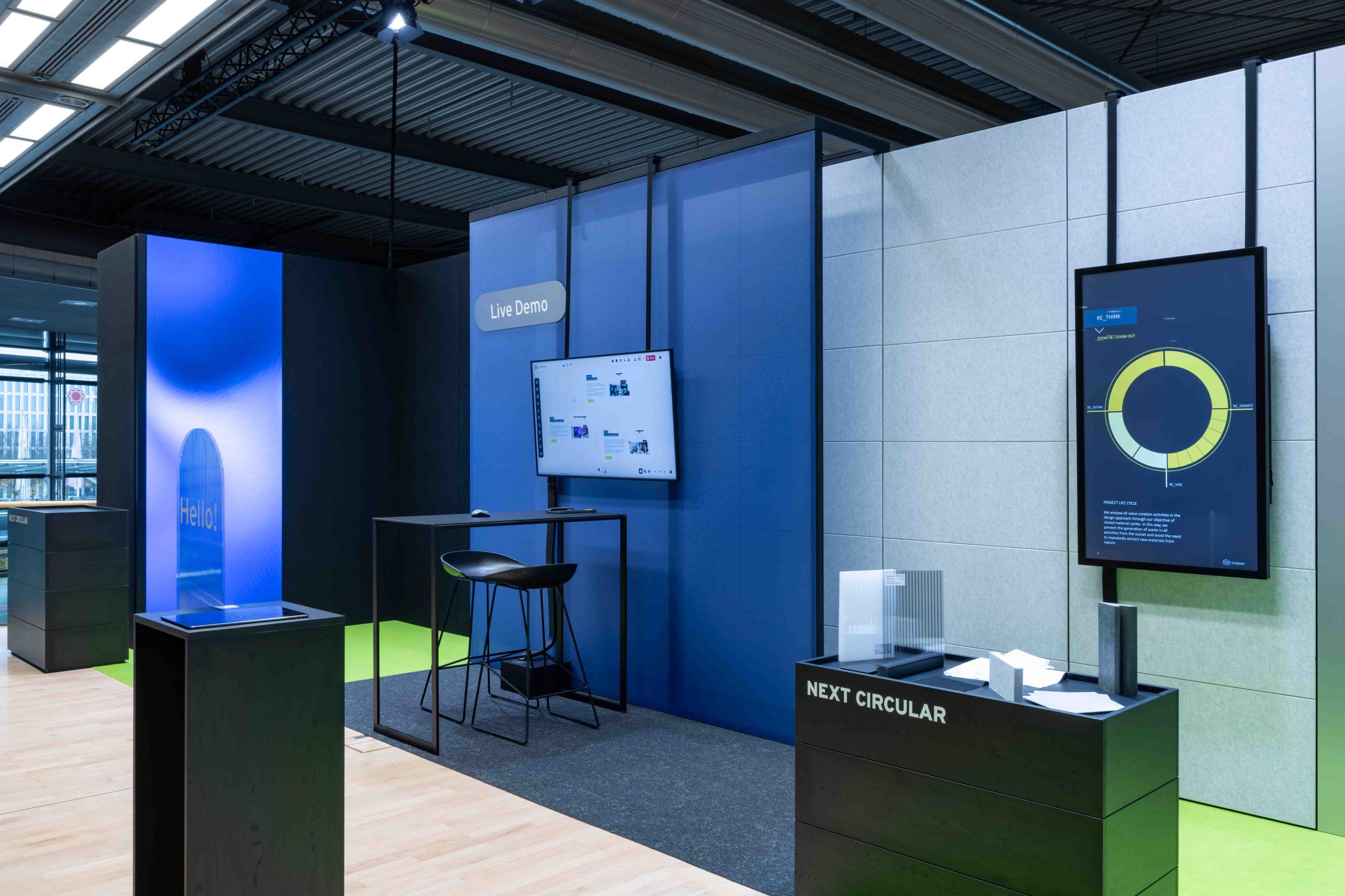
Anyone exhibiting at a trade fair for the first time, usually raises more unanswered questions than it provides practical insights: What size stand is suitable? How much should the budget be? What needs to be decided first? And how do you prevent technical, graphic and logistical issues from all cropping up at once just before set-up?
A first trade fair appearance is not a project that simply comes together spontaneously on the floor. Organisers set deadlines, exhibits require space and power connections, the team needs a briefing, and every additional request has an impact on the budget or the schedule. sectorplan has been supporting trade fair appearances for over 50 years. That’s why, particularly for a first appearance, a clear sequence of steps is helpful: first clarify the objectives and overall framework, then plan the stand and technical requirements.
Why first-time exhibitors need to plan differently for the trade fair
Experienced exhibitors know their processes inside out. They know which areas work well, how many meetings the team can handle in a day at the trade fair, and which technology is actually used. When exhibiting for the first time, these benchmarks are lacking. As a result, decisions are often made on the basis of appearance, gut feeling or individual preferences.
So don’t start by asking what the stand should look like. First, clarify what you want to achieve after the trade fair: more qualified leads, specific demo appointments, meetings with existing customers, contacts with retailers, recruitment or a product launch. The answer will determine which features your stand really needs.
For the basic project structure, please see the page Trade fair planning the key stages of planning, technical arrangements and logistics. This article deliberately focuses on the decisions that are particularly often underestimated when exhibiting at a trade fair for the first time.
Tips for first-time exhibitors on setting targets and managing their budget
At a trade fair debut, there are many things going on at once. It becomes easier if you organise the decisions into a fixed sequence. The following points form the basic framework for further planning.
1. Set a measurable trade fair objective
A stand cannot offer maximum product display space, plenty of seating, a large stage and unobstructed walkways all at the same time. You should therefore prioritise one main objective and add no more than a few secondary objectives. For a mechanical engineering firm showcasing a new packaging system, for example, meeting technical decision-makers and attending pre-arranged demonstration sessions may be more important than making as many contacts as possible.
The following overview shows how the objective, monitoring function and performance review are interrelated:
| Objective | Impact on the stand | How you measure success |
|---|---|---|
| Attracting new customers | Open communication and clearly identifiable discussion areas | Qualified leads with a clear next step |
| Explain the product | Demonstration area, exhibit and appropriate audiovisual equipment | Confirmed demonstration dates and specific enquiries for quotations |
| Contact a dealer | Sample display and quiet meeting areas | Discussions with the purchasing department and concrete interest in product placement |
| Strengthen the brand | A clear corporate identity and a distinctive visual impact from a distance | Relevant visitors, press briefings and documented feedback |
2. Calculate the budget as part of the overall project
Stand hire and stand construction are only part of the bill; depending on the trade fair, other costs such as organiser services, electricity, internet, cleaning, graphics, transport, assembly, travel, accommodation, staff and follow-up work may also be incurred. Plan these areas separately from the outset so that any additional costs that arise later remain transparent. You can find a detailed breakdown of costs in the article Planning your exhibition stand budget efficiently.
Stand layout and concept for the first exhibition appearance
3. Prioritise functionality over square metres
The amount of space you need depends on your team, the exhibits and the discussions that will take place. You should therefore first make a list of what needs to happen on the stand: reception, product presentation, demonstration, consultation, storage or confidential discussions. Only then can you assess whether the space you’ve booked can accommodate these functions without cramped walkways or unused areas.
The layout of the stand also affects how it is used. A row stand directs visitors in from one side, a corner stand opens up two sides, and an end stand opens up three. Having more open sides only makes sense if the stand’s design and staffing can actually cater for the additional points of contact.
4. Streamline the stand concept to convey a clear message
When setting up your first stand, it’s easy to feel the urge to showcase as much as possible, with the result that products, claims, screens and graphics all compete for the visitor’s attention. Instead, work with a clear hierarchy. Visitors should first understand what the stand is about as they approach from the aisle, then learn more in a targeted way at the stand itself, and finally find a clear reason to engage in conversation. sectorplan describes how brand messaging, spatial logic and technical requirements are brought together on the page about Exhibition Stand Design.
Choose the construction method and media technology to suit the application
5. Choose the construction method based on the intended use
If further trade fairs are planned following the launch, a modular system allows basic elements to be reused for stands of different sizes. Graphics, lighting and customised components can be adapted to suit each specific application. sectorplan works with Aluvision-Systembau, amongst others, and supplements this with components from its own production where required. You can find out more at modular exhibition stand.
If stand sizes and future exhibition formats have not yet been finalised, a rental model may be a sensible option to start with. You can find further information on this on the page Rent or buy an exhibition stand.
6. Only include media technology in the plan if there is a specific task
A screen or LED wall should be used to explain a product, make content visible from a greater distance or support a demonstration. Without a clear purpose, the technology ties up budget, electricity and support resources without enhancing the conversation at the stand. Technical details on the integration of large display surfaces can be found at sectorplan at LED wall at the exhibition stand.

Common mistakes when exhibiting at a trade fair for the first time
Many problems arise weeks before the exhibition and often only become apparent once on the exhibition floor. The following mistakes are particularly common:
- Too much in too small a space: Exhibits, furniture and displays are blocking the aisles and making it difficult to get a clear view of the stand.
- No clear main message: Visitors see a lot of content, but do not immediately understand which offer is relevant to them.
- Late approvals: Changes to graphics, product dimensions or technology have an impact on both production and logistics.
- An unprepared stand team: A good level of specialist knowledge is no substitute for a shared goal, opening questions or rules for lead generation.
- Follow-up without responsibility: Although contacts are collected, they are not prioritised or assigned a next step.
That is why, particularly when exhibiting at a trade fair for the first time, you should not cut corners when it comes to coordination. A well-designed stand is of little use if the exhibits arrive late or if no one has been appointed to handle technical queries, important contacts and follow-up tasks.
Preparing the trade fair team for discussions and leads
The stand provides the framework; it is your team who actually make the contact. Before the trade fair, you should therefore have a clear idea of which visitors are particularly relevant, what information is needed during the conversation, and what can be offered as the next step. This will help you avoid ending up with a lot of contact details but hardly any useful information from the conversations.
Specific opening questions are more helpful than a general “May I show you something?”. Depending on what you’re offering, questions such as “How do you currently handle this process?” or “What would a new solution need to improve for your organisation?” can lead straight into a technical discussion.
Briefing points for stand staff
- Target groups and key contacts
- key message of the trade fair presentation
- Introductory questions and typical follow-up questions
- Criteria for high-priority and less urgent leads
- Mandatory information for meeting notes
- next steps, such as an appointment, a demonstration or a quote
- Responsibilities per shift and in the event of technical problems
Lead capture should be simple enough to ensure that it is actually used during the trade fair. The key is not to include as many fields as possible, but to gather information that the sales or project team can use to continue their work after the trade fair.

Timetable for first-time exhibitors with fixed deadlines
The most common source of time pressure arises from decisions that remain unresolved for too long. Event organisers set deadlines for orders and technical requirements, service providers need production time, and internally, designs, graphics or budgets must be approved. You should therefore plan backwards from the set-up date and assign a fixed date to every internal decision.
For larger flagship trade fairs, it makes sense to start preparations nine to twelve months before the event; for smaller events, a shorter lead time may suffice. The key factors are stand size, technical requirements, exhibits and the organiser’s deadlines. sectorplan suggests a timeframe of four to six months for smaller trade fairs, provided that the stand area and key project details have been finalised.
A guide to your first trade fair appearance
- 12 to 9 months beforehand: Choose a trade fair, set your objectives, enquire about stand space and determine your budget.
- 9 to 6 months beforehand: Coordinate functions, floor plan, design style, exhibits and technology.
- 6 to 3 months beforehand: Finalise the graphics, logistics, event management services, travel arrangements and staff planning.
- 3 to 1 month beforehand: Brief the team, test the lead process, review the content and coordinate handovers.
- After the fair: Prioritise contacts, arrange follow-up meetings and document insights for the next engagement.
For further details on the organisational and technical steps involved in installation and handover, please see Setting up and dismantling an exhibition stand.
Choosing the right trade fair before planning the stand
A well-known event isn’t necessarily the right one for your first appearance. Check whether the visitor profile, industry focus, exhibitor mix and event format align with your objectives. A smaller, specialist event with a high proportion of relevant decision-makers may be a more sensible way to get started than a large trade fair, where your team will only reach a small proportion of the audience.
To do this, make use of the official exhibitor directories, hall plans and organiser’s documentation. These will show you which companies are located near you, which halls are thematically suitable and which technical regulations apply. This information should always be checked for the specific event, as stand locations, hall allocations and service conditions are subject to change.
Checklist for the day of the trade fair and follow-up work
The first day of the trade fair will reveal whether the planning was practical. A quick check before the doors open prevents many minor problems that would otherwise cost time later on.
- Check status: Check the graphics, lighting, technical equipment, exhibits and storage space.
- Set up a team: Go through the day’s objectives, roles, breaks and important appointments together.
- Test lead capture: Check that notes, consents and next steps are stored reliably.
- Refill the material: Do not leave samples, documents and consumables lying around in the visitors’ area.
- Make the most of the end of the day: Prioritise important contacts and make a note of outstanding tasks whilst the details of conversations are still fresh in your mind.
After the trade fair, you shouldn’t just look at the number of contacts made. Compare your original targets with qualified leads, agreed appointments, requests for quotations and feedback from your team. This analysis will provide you with your first reliable benchmark for your next trade fair appearance.
This is how sectorplan supports first-time exhibitors
sectorplan supports trade fair projects from concept and design, through system construction and in-house manufacturing, to media technology, logistics, set-up and dismantling. For companies with no prior trade fair experience, a centrally coordinated project primarily reduces the number of points of contact that need to be managed internally. How the stand is implemented, both technically and in terms of design, depends on the trade fair, the floor space, the brand and the exhibits.
If you are planning your first trade fair appearance, please send details of the trade fair, the stand space required, your target audience, the exhibits, the dates and your budget via the sectorplan’s contact page. On this basis, it is possible to determine at an early stage which stand design, construction method and features are best suited to your project.
Frequently asked questions from first-time exhibitors at the trade fair
For major trade fairs, it is advisable to begin preparations nine to twelve months before the event. Smaller trade fairs can often be planned with less lead time if the stand space, exhibits and internal approvals are finalised early on. The organiser’s specific deadlines and the scope of the stand project are always the decisive factors.
The costs depend on the stand area, construction, technical requirements, exhibits, logistics, staffing and the venue. You should also factor in the organiser’s services, electricity, internet, cleaning, graphics, travel and post-event follow-up. A reliable cost estimate therefore requires details of the specific trade fair, stand area and fit-out.
There is no standard square metreage. The key factors are how many people will be working on the stand, what exhibits require space, and whether you need areas for demonstrations, meetings or storage. Start by planning these functions and work out the required space from there.
For a first appearance, a hire stand may be a sensible option if stand sizes and future exhibition formats have not yet been finalised. Purchasing becomes more relevant when components are used regularly and storage, maintenance and logistics can be organised on a long-term basis. sectorplan offers modular systems for both flexible hire solutions and recurring use.
Define your target audiences, opening questions, mandatory information and possible next steps in advance. The team should also know which contacts to prioritise and where to record notes from conversations. Brief practice conversations before the trade fair will highlight any differences in the way you approach people.
Suitable metrics are those that align directly with your trade fair objective, such as qualified leads, agreed appointments, demos or specific enquiries for quotes. Supplement these figures with feedback from the stand team on frequently asked questions and objections. This will provide a basis on which you can plan your next trade fair appearance in a more targeted manner.
