
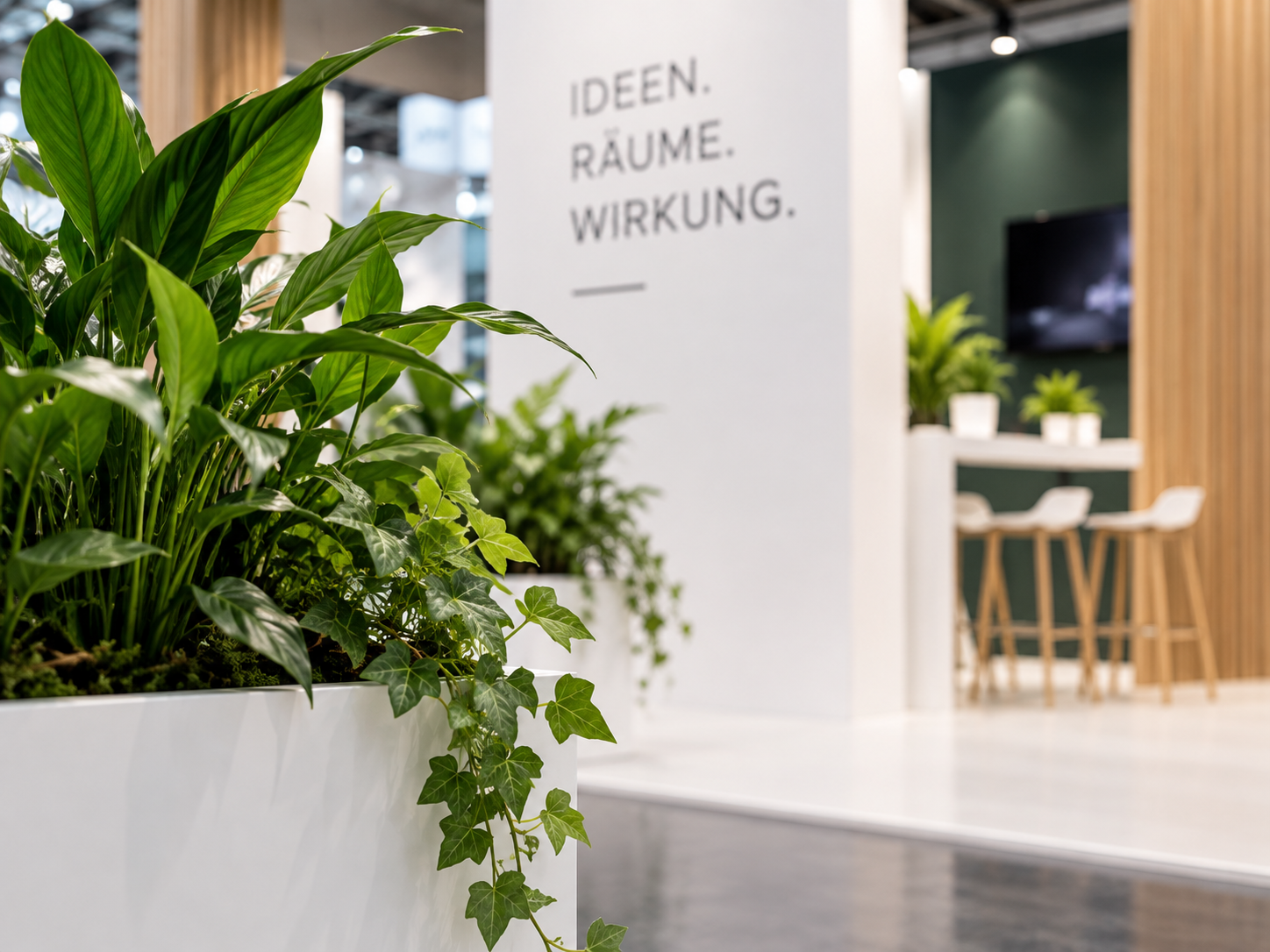
Showcasing plants sustainably at trade fair stands: How to combine brand impact with environmental awareness at trade fairs
Plants at exhibition stands transform a functional stand into a vibrant brand experience. Amidst bright halls, concrete floors and technical equipment, they convey a message at first glance: This is about people, the environment and responsibility. For us at sectorplan GmbH, plants are among the most effective tools in modern, sustainable exhibition stand construction.
Why plants are now a must-have at exhibition stands
Trade fairs are evolving rapidly. Visitors expect experience-driven, sustainable brand spaces rather than traditional product displays. Trends in trade fair and interior design clearly show that: biophilic design, that is, the deliberate incorporation of nature, is set to be one of the key design themes in the coming years. Real greenery, natural materials and soothing colours create a pleasant atmosphere, reduce stress and encourage conversation.
For exhibitors, having plants on their stands offers three key benefits:
- Greater visibility in the exhibition hall
Plant features, trees, green walls or islands act as focal points within the exhibition hall. Visitors use them to find their bearings, pause, take photos and take a step closer to your stand. - A credible message on sustainability
Anyone talking about ESG, CO₂ reduction or the circular economy will win people over by creating an environment that brings this approach to life. Green exhibition stands They emphasise every conversation about sustainability – without saying a word. - Longer visits and better conversations
A green seating area with pleasant acoustics and soft lighting creates the ideal environment for consultations, contract negotiations and networking. When visitors feel at ease, better leads are generated.
As Aluvision Ambassador Partner At sectorplan, we combine modular, resource-efficient systems with green elements. The result is an exhibition stand that functions with technical precision whilst also feeling like an urban oasis.
Using plants strategically at exhibition stands: zones, functions, messages
Plants at exhibition stands are not just for decoration. They help to organise the space, guide the flow of visitors and bring your brand to life within the space.
Entrance area: The first second counts
The entrance area is crucial in determining whether visitors pass a stand by, regarding it as irrelevant, or perceive it as inviting. A carefully designed scenic plant display can act here like a green portal make an impact and attract attention. Shrubs or tall specimen plants frame the entrance and clearly define the access point. Linear planters give structure to the layout of the paths and highlight entry points, whilst carefully placed floral accents in the brand colours create visual recognition and subtly yet effectively reinforce the brand identity. In combination with a modular exhibition stand With sectorplan, a striking entrance area is created using just a few elements. Read more about this thoughtful design in the article Trade fair planning.
Product zones: Balancing technical content with nature
To create in product or technology areas Plants at exhibition stands: carefully placed focal points within the field of vision. They give structure to the space and draw the eye without detracting from technical details or exhibits. Grasses and small-leaved plants that provide structure are particularly suitable, as they convey a sense of lightness and visually break up large areas. Vertical plant elements are equally effective, framing equipment or exhibits and providing them with a clear showcase. In addition, subtle planting areas between interactive stations to create natural transitions and guide visitors smoothly through the space. The combination with LED video walls. An LED display featuring dynamic nature scenes, combined with real greenery, creates striking, immersive images. You can find practical examples of this on our page on LED video wall by Aluvision.
Lounge and conversation areas: The green comfort zone
As soon as visitors take their seats, the focus shifts from simply looking to a spatial experience. In conversation areas, the emphasis is less on presentation and more on atmosphere and the quality of the experience. We recommend Plant arrangements at eye level when seated, which create a sense of intimacy and make the room feel cosier. Rather than individual pieces, they have the effect of loose clusters of plants look more natural and create a harmonious overall appearance. In addition, you can Acoustic planters and moss-covered areas for noise reduction contribute by reducing noise levels and fostering a pleasant, focused atmosphere for conversation. In high-traffic areas, such as at leading trade fairs in Munich, Frankfurt or Stuttgart, a thoughtfully landscaped lounge is particularly beneficial. Our completed projects and our approach in the Full-service exhibition stand construction.
Real plants, artificial plants or moss? A systematic selection for your exhibition stand
There is no one-size-fits-all answer to the question of whether to use real or artificial plants on a exhibition stand. The key factors are the space available, the duration of the event, maintenance options and your brand message. The table below provides an initial overview.
- Real plants for exhibition stands: living ambassadors for your sustainability
Real plants help to create a credible brand story – particularly at trade fairs focusing on the environment or energy. They subjectively improve air quality and allow Temperature and light curves appear more subtle and convey multisensory impressions such as leaf texture, scent and tactile sensation. Robust, location-tolerant species are suitable for use at trade fairs, such as Ficus, Yucca, Dracaena or large-leaved philodendrons. In spaces with natural light, olive trees or Mediterranean trees and shrubs can also be harmoniously incorporated, for example in outdoor areas or in glass-roofed atriums. - Artificial plants: Predictable aesthetics and perfect reusability
High-quality artificial plants offer maximum planning reliability and can be used identically across several trade fair cycles. They can be stored easily and reuse in different stand designs. In a modular construction system – such as one based on Aluvision – this significantly reduces resource consumption over the entire life cycle. Particularly useful are Artificial plants for events lasting several days where maintenance windows are few and far between; in international roll-outs with an identical brand identity; or in combination with sensitive media technology, where humidity can be a problem. - Moss walls and vertical greenery: brand displays with a sense of depth
Vertical greening elements such as moss walls, planted frames or modular plant walls make targeted use of the height of the exhibition stand and produce a remote effect, without taking up any extra floor space. They combine Branding and atmosphere, by presenting them as dynamic brand spaces. In modular designs, such elements can be systematically integrated into framework structures or bespoke structures.


Concept: How exhibition stand plants convey your brand message
Plants never appear neutral – they convey Values, sentiments and substantive messages. The more precise the concept, the greater its impact on the space. The first crucial step is to translate the Branding values in a consistent visual identity for plants: A technology-oriented company with a focus on efficiency tends to use clean lines, structured grasses and minimalist containers with a concrete or aluminium finish. A food or agricultural brand credibly emphasises edible plants, herbs, fruit-bearing shrubs and natural materials such as wood or enamel. Financial or insurance brands, on the other hand, benefit from imagery that conveys stability – large, robust solitary plants, long-lived shrubs and understated colours. From the Brand Mission Statement This creates a integrated approach, which has been carefully thought through, from the choice of flooring to the lighting design. In this article, we show what a holistic approach to sustainable exhibition stand construction looks like Sustainable exhibition stand.
Equally important is the Colour harmony between the plant world and corporate design. The plants do not need to match the CI exactly, but they look much more professional if the leaf structures, flowers and vessels are coordinated: deep green, glossy leaves and white accents complement blue brand identities; for green brands, wood, beige or warm metallic tones create a deliberate Contrast; bold shades of red or orange are best complemented by plants with dark foliage and understated, natural containers. Via specific lighting effects – for example, in conjunction with a Exhibition technology equipment – this effect can be enhanced without losing its natural look.
After all, plants can also form part of a spatial storytelling . At the entrance, striking, eye-catching plants serve as a visual focal point. Along a walking route, smaller, thematically coordinated arrangements the content. In the final or conversation area, denser, calmer greenery creates a focused atmosphere. This results in a visitor flow that subtly guides people – less like a traditional wayfinding system, and more like a overarching theme throughout the entire stand.
Practical planning: From the initial idea to the green exhibition space
To ensure that plants at exhibition stands look just as impressive in reality as they do in the visualisation, careful planning is required, based on a number of key questions.
Site analysis and hall conditions
The first step is a detailed analysis of the framework conditions. The key factors are the Lighting conditions – such as skylights, greenhouse windows or the existing LED lighting – as these have a significant influence on which plant species are suitable for use. Equally relevant is the Load capacity In terms of space: floor loads, designated escape routes and fire safety requirements set clear limits on the positioning and size of the greening. Added to this is the Accessibility of the venue, i.e. delivery routes, storage areas for pallet trucks and available time slots for set-up and dismantling. These conditions can vary significantly between exhibition venues such as Munich, Frankfurt and Stuttgart. Accordingly, we always plan plant installation, logistics and watering as an integral part of stand construction and technical infrastructure – not as an add-on, but as a key component of the overall concept.
Rented plants or your own plants?
For most exhibitors, a Plant Hire Scheme the most sensible solution from both an economic and organisational perspective. It significantly reduces the company’s own responsibility for handling, transport and temporary storage, and takes the pressure off internal resources. At the same time, a a range of plants that is up-to-date and tailored to the season is available that suits the respective event in terms of both aesthetics and atmosphere. Thanks to its flexible configuration, the concept can also be adapt flexibly to different stand sizes and layouts, without having to invest in new ones every time. On the other hand, those who place great emphasis on brand recognition or use concept stands that are reused year after year benefit from having their own plant elements that can be reused (such as modular frames with artificial plants or moss panels).
Maintenance and operation during the trade fair
A green exhibition stand only works if it has a clearly defined Operating concept. These include structured Irrigation plans and irrigation systems integrated as discreetly as possible, which do not detract from the design. Similarly, the Access to water connections or mobile tanks be planned well in advance to ensure a secure supply during the trade fair. After all, clear responsibilities for care staff crucial to ensure that watering, monitoring and any plant replacements can be carried out smoothly and without disrupting the running of the exhibition. In the sectorplan’s full-service approach We can incorporate these tasks into our service package as required – from set-up and dismantling to on-site support throughout the event.
Sustainability: How exhibition stand plants can support your ESG targets
Companies are increasingly under scrutiny at trade fairs: stakeholders expect credible sustainability measures, even in the case of temporary structures. Strategically placed plants at exhibition stands make a measurable contribution here – particularly when combined with Reuse and the circular economy. In our Aluvision-based modular construction system, we combine modular frame systems, reusable planting modules and containers as well as long-lasting artificial plants or hard-wearing real plant schemes into a flexible modular system that can be reused at various trade fairs, in showrooms or at in-house events. Please also read our article on this subject Exhibition stand construction with a system.
Wherever possible, we also rely on regional sourcing and seasonal concepts: Working with local florists and keeping delivery routes short reduces emissions, whilst seasonal arrangements minimise wastage and strengthen the focus on regional sourcing – for example, for events in southern Germany. Also with regard to Certifications such as Green Events or Green Exhibitions Well-thought-out plant concepts offer a number of advantages: documented reuse, transparent transport accounting and a conscious selection of substrates and container materials create a robust basis for reporting. As a result, a green exhibition stand impresses not only visually but also in terms of its sustainability documentation.
Here’s how we’ll help you set up your eco-friendly exhibition stand
At sectorplan GmbH, with over 50 years’ experience in exhibition stand construction and a strong focus on sustainability, we view plants in exhibition stands as a strategic component of your brand communication. Our process:
- Analysis & Briefing
Brand positioning, objectives of the trade fair presence, target audiences, key messages relating to sustainability. - Concept & Visualisation
Development of a stand design featuring a clear planting strategy, zoning, and a concept for materials and colours. - Technical Planning & Logistics
Integration of irrigation, structural engineering, fire safety, transport and storage – all from a single source. - Implementation & on-site support
Set-up, fine-tuning of the plant displays, and ongoing maintenance during trade fairs lasting several days, by arrangement. - Analysis & Re-use
Documentation, optimisation for future events, and the reuse of plant modules and stand components.
If you’re planning your next event and would like to make strategic use of plants on your exhibition stand, it’s worth taking a look at our page Successful planning and realisation for your trade fair stand. If you have any specific queries, our team is available via the Contact page available.
Frequently asked questions about plants for exhibition stands
Robust, light-tolerant plants such as ficus, dracaena, schefflera, palms or large-leaved philodendrons are suitable for exhibition stands. These exhibition stand plants can tolerate varying light conditions, short periods of drought and frequent changes of location. In high-ceilinged halls, large, freestanding plants such as olive trees or bamboo also work well, whilst in product display areas, more compact, structure-adding plants and grasses are preferable.
Both have clear strengths. Real plants at exhibition stands create a particularly authentic, natural look and reinforce your sustainability message. Artificial plants, on the other hand, offer maximum planning certainty, require no maintenance and can be reused for many years. sectorplan frequently combines both options: real plants in lounge or feature areas, and high-quality artificial plants in hard-to-reach areas or locations where maintenance is limited.
For exhibition stand plants on a hire basis, a service partner or the stand-fitting team takes care of delivery, positioning and maintenance. This includes watering, trimming individual leaves and, where necessary, replacing weaker plants. For real plants, we schedule fixed inspection times and coordinate access points and water sources with the trade fair organisers in advance. Artificial plants do not require ongoing maintenance; they only need occasional cleaning.
Yes. Reuse plays a key role, particularly when used in conjunction with modular exhibition stands. High-quality artificial plants and sturdy planters can be used for several exhibition seasons, whilst reusable modules such as moss walls can be integrated into stands of various sizes. sectorplan takes reuse into account right from the concept phase, ensuring that your exhibition stand plants contribute to sustainable exhibition stand construction in the long term whilst also saving costs.
